


Parlons Sciences
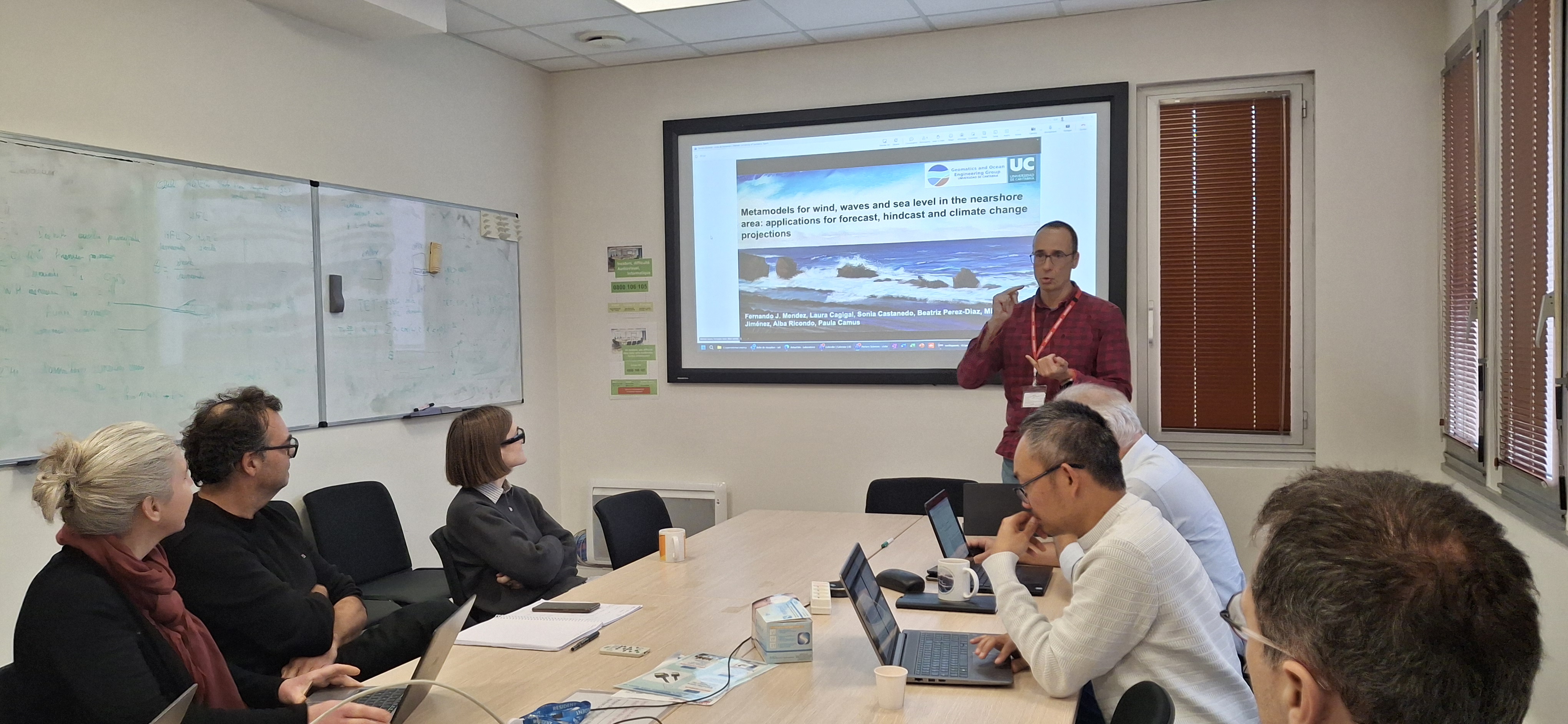
Visit by Dr. Fernando Méndez, full professor of Coastal Engineering at University of Cantabria (Spain),
where is the head of the research group on “Geomatics and Ocean Engineering”.
Metamodels for wind, waves and sea level in the nearshore area: applications for forecast, hindcast and climate change projections.
He came to see us to demonstrate the BlueMath plateform :
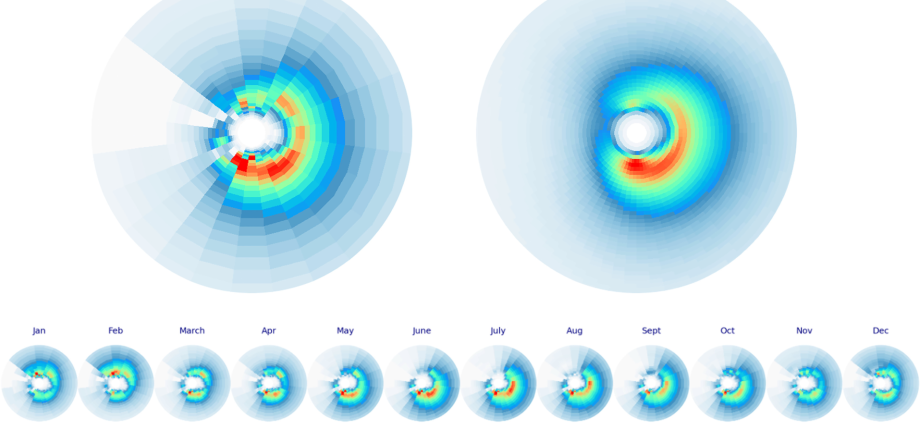
To address the computational limitations of dynamic downscaling while leveraging their efficiency and accuracy, hybrid methods (i.e., metamodels, hybrid or surrogate models) have emerged as viable alternatives to fully dynamic downscaling to downscale waves (Camus et al., 2011, Ricondo et al., 2023, 2024) or for evaluating waves induced by tropical cyclones (van Vloten et al., 2023). These methods integrate the precision and detail of dynamical models with statistical methods and machine learning techniques, thereby offering cost-effective predictive capabilities.
We will show two types of metamodels:
(a) hybrid models that operate by first selecting a representative subset of scenarios from the parameter space, which are then simulated using a numerical model. Subsequently, these simulations serve as the basis for training the algorithm for constructing an interpolation surface. This surface enables to expand the predictions beyond the initial dynamical model realizations, and
(b) additive models, which are based on the principles of classical Green’s functions. These models enable the segmentation of the physical wave downscaling process into several subprocesses (Cagigal et al., 2024).
Consequently, the reconstruction of an event involves the linear combination of responses from individual subprocesses, thereby eliminating the necessity of selecting a limited number of cases and broadening the applicability of the method to future wave climates and conditions never observed in the historical records. Several applications in different coastal regions at different spatial scales (regional scale, local scale, high-res scale) will show the potential of these techniques for downscaling waves, surge levels for forecast, hindcast and climate change projections.