


Parlons Sciences
Notre postdoc, Maxime CANARD, nous parle de ses travaux :
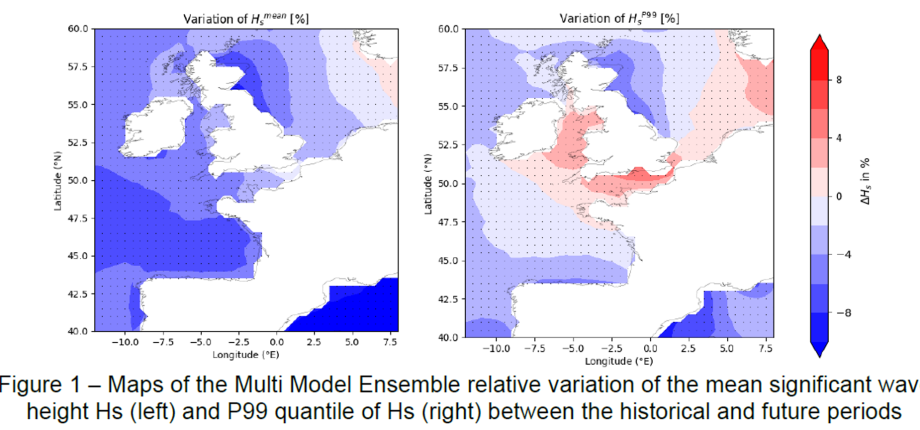
Predicting wave climate evolution in the 21st century is crucial for assessing future marine and coastal hazards, e.g. coastal flooding, and erosion risks. Along Western European coastlines, the influence of climate change on the wave climate remains unclear, with no definitive trends identified, especially for extreme events. To address this issue, we use an open-access CMIP6 global wave projection database (Meucci et al., 2024), including 8 datasets generated using the wave model WaveWatchIII forced with wind data from 8 General Circulation Models (GCM), under the SSP5-8.5 scenario. We study the evolution of the wave climate between 1985-2014 (historical period) and 2071-2100 (future period) in a spatial domain surrounding the Western European seas.
The database is first assessed by comparing the historical period data with the higher spatial resolution regional reanalysis database ANEMOC3, developed by EDF R&D and covering the period 1979-2024. ANEMOC3 was built using the TOMAWAC wave model forced by CFSR-CFSV2 reanalysis wind data and validated against buoy and satellite data. Region-wise analysis of the SSP5-8.5 climate change scenario wave projection data shows wave climate evolution in several parts of Western Europe.
This study provides a clear view of the evolution patterns for the mean and extreme values of the significant wave height, peak period, and mean direction. Special attention is given to the GCM and wave model uncertainties. GCM uncertainties are assessed with statistical significance tests. Finally, the wave model uncertainty is evaluated by comparing evolution patterns obtained for one GCM with a regional projection using the ANEMOC3 model forced by the same GCM winds.