


Parlons Sciences
Notre doctorant, Thomas BRUNEL, nous parle de sa thèse : Paddle sports physics: Velocity--stroke rate and active drags
Abstract : In swimming competition, among all the swimming style, front crawl is the one which allows to reach the highest speed and appear to be the most efficient (Barbosa, et al., 2010). Thus, it is the stroke use in all the freestyle events. It covers a range of distance from 50 m to 1500 m in swimming pool and from 5 km to 25 km for open water swimming. Front crawl swimming is characterized by an alternate action of the arms. A cycle is composed of three main phases for each arm: a gliding phase just after the hand entry into the water with one arm extended forward; a propulsion phase (pull and push) and a recovery phase.
The frequency of this cycle is commonly called stroke rate. The study of the relationship between velocity and stroke rate leads to focus on arm organization during a cycle (Chollet, Chalies, & Chatard, 2000). In their work, Carmigniani et al. (Carmigniani, Seifert, Chollet, & Clanet, 2020) present a propulsion model to explain the general evolution of the coordination based on the minimization of energy during a cycle. This model outlines two regimes. The first one at low speed where the swimmers vary their speed with the force they use per stroke and maintain constant coordination. The second one appears when a critical velocity is reach which means that the swimmers are at maximum force. In order to further increase the swim velocity, they start to reduce the gliding and recovery phases.
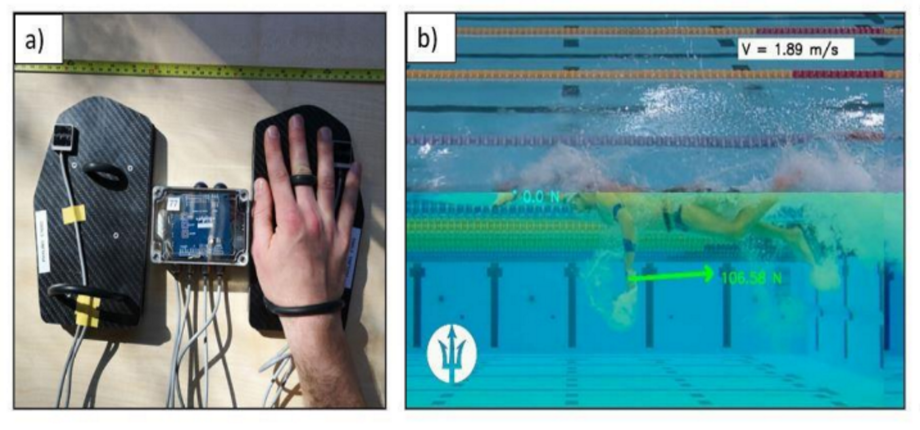
In this study, we propose a first validation of this model through a progressive speed test, using instrumented paddles to measure the force generated by the arms of the swimmers and a video recording system to measure the velocity.