


Parlons Sciences
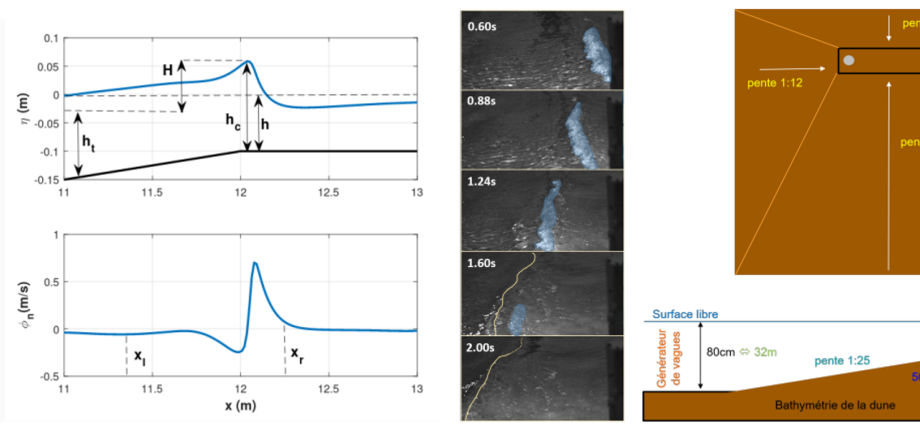
Notre doctorant, Jiankai WANG, nous parle de sa thèse : Machine learning applications to experimental and numerical modeling of offshore breaking waves.
With the increasing demand for accurate and efficient simulations in fluid mechanics, AI-driven approaches like Physics-Informed Neural Networks (PINNs) have the potential to enhance our understanding and prediction of wave dynamics. PINNs combine data-driven neural networks with physics-based constraints by incorporating the residuals of physical equations into the total loss function. The optimization strategy aims to minimize the total loss, ensuring that the neural network's outputs closely match the target values.
In this study, we build upon the Deep Operator Network (DeepONet), which has been validated in solving both ordinary differential equations (ODEs) and partial differential equations (PDEs). Our goal is to train a neural network that maps inputs, including horizontal coordinate x, vertical coordinate z, and time t, to the corresponding outputs, which include the velocity potential Φ and the free surface elevation η. In this architecture, the Laplace equation serves as the governing equation, while the free surface boundary conditions, particularly the dynamic and kinematic equations, are incorporated into the loss function to ensure the results adhere to physical laws.
Given the complexity of wave propagation, the training and validation of our neural network begin with the simplest linear wave theory. Moving forward, we plan to extend the model to stokes waves, cnoidal waves, and even irregular waves. Additionally, the training data will progressively expand from theoretical solutions to numerical simulations and experimental data.