


Parlons Sciences
Visit by Jie Zhang (Assistant Professor Harbin Engineering University) and Yuxiang Ma (Professor at Dalian University of Technologies.), China, to talk about ..
Extreme Wave Slamming on Side-by-Side Piles: Finite-Crest Effects (Yuxiang MA)
Wave slamming on side-by-side piles was investigated using a validated CFD model and strip theory, with emphasis on finite crest geometry. The effects of pile spacing (SG/D), finite water length (Lw/D), and Froude number (Fr) were examined systematically. Besides the known reduction in slamming coefficient Cs at small Lw/D, a secondary force peak was identified during Cs decay, caused by constricted gap flow and enlarged high-pressure zones. This peak could exceed 300% of that of an isolated pile. Sensitivity analysis showed Lw/D dominated Cs. An artificial neural network predicted Cs at key phases with high accuracy (R² > 0.97).
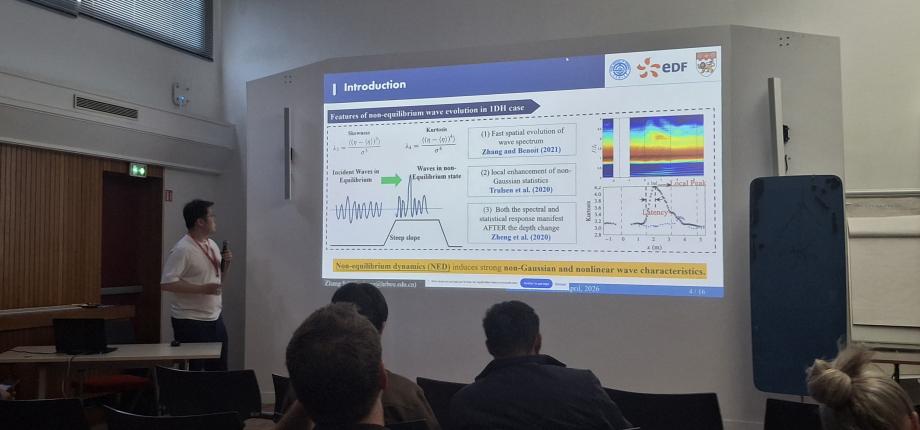
Non-equilibrium dynamics of directional wave fields induced by rapid depth variation (Jie ZHANG)
Recent studies have demonstrated that irregular waves propagating over rapid depth variations can exhibit evident non-equilibrium dynamics. When waves are driven out of equilibrium, nonlinear wave-wave interactions induce significant spectral evolution and non-Gaussian statistics within a relatively short spatial region spanning only a few wavelengths. As a result, the occurrence probability of freak waves is substantially enhanced, posing severe threats to coastal engineering structures.
However, previous studies have predominantly focused on long-crested waves propagating in two-dimensional wave flumes. Only a limited number of numerical studies have considered directional wave fields or complex bathymetries in three-dimensional scenario, yet these have yielded contradictory conclusions regarding the role of directional spreading angle in the local enhancement of skewness and kurtosis.
In this work, we presented a systematic experimental investigation into the effect of wave directionality on non-equilibrium wave evolution. Both normal and oblique incident waves, with varying directional spreading (long-crested and short-crested), were tested as they propagated over a submerged bar. Our results demonstrate that the directional spreading angle plays an insignificant role in amplifying skewness and kurtosis after the depth change, whereas the wave incident angle is the dominant factor, as it governs the effective bottom gradient experienced by the wave field.