


Parlons Sciences
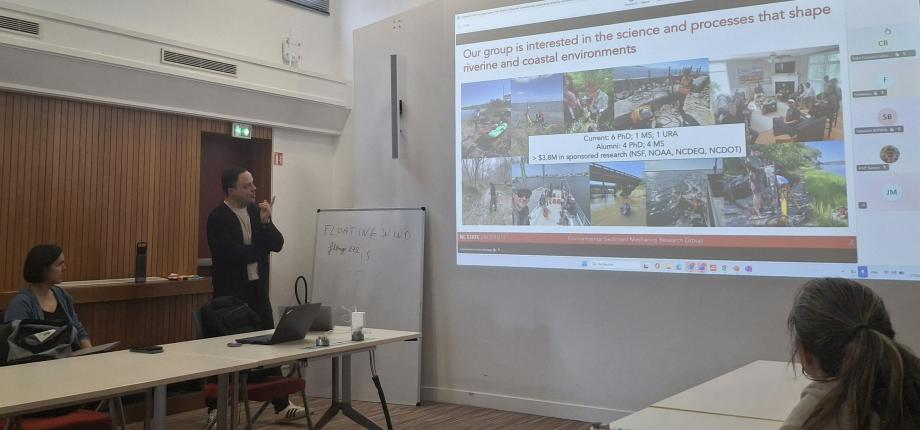
Visit from Celso CASTRO-BOLINAGA, North Carolina University, USA to talk to us about ..
From Rivers to Estuaries: Characterizing Longitudinal Variability of Sediment Erodibility.
Aquatic environments, from rivers to estuaries, are continuously adjusting their form in response to hydrological fluctuations (including extreme events), changes in the quantity and size of supplied sediment, and anthropogenic modifications (e.g., infrastructure construction and removal). Characterizing the inherent variability that marks such adjustments in nature is thereby fundamental to advance the formulation of physics-based numerical models that underpin predictive understanding. This is critical nowadays given the impact of climate change on aquatic environments, which have altered their water-sediment regimes and their capacity to resist and recover from change imposed by disturbances (i.e., their resilience).
This presentation covered recent field efforts to characterize the longitudinal variability of sediment erodibility from rivers to estuaries. In riverine environments, data from an extensive field campaign within the City of Raleigh in North Carolina, USA has been presented to show how compounding effects between sediment properties and hydro-environmental conditions (e.g., moisture content) impact the variability of bank erodibility. In coastal environments, measurements of sediment erodibility around the Rachel Carson Reserve and the Beaufort Inlet in coastal North Carolina, USA has been presented to highlight the impact of shell fragments on the variability of bed material composition and behavior.